The Machine
No CPU, no ROM, no screen. TRAPSHOOT is lamps, gels and a few dozen TTL chips - and the owner's manual explains every decision the board makes.
Gremlin Industries
Gremlin was founded in San Diego by Frank Fogleman and Carl Grindle as a contract engineering firm. The name was supposed to be "Grindleman Industries" - a mash-up of the two founders' names - but it was misheard over the phone during incorporation and came out Gremlin.
In 1973 Gremlin started building coin-operated wall games, beginning with Play Ball. TRAPSHOOT followed in 1975. A year later Gremlin released its first video game, Blockade (1976), and in 1978 the company was bought by Sega, becoming Gremlin/Sega - the name behind Head On, Carnival and the North American releases of Frogger and Zaxxon.
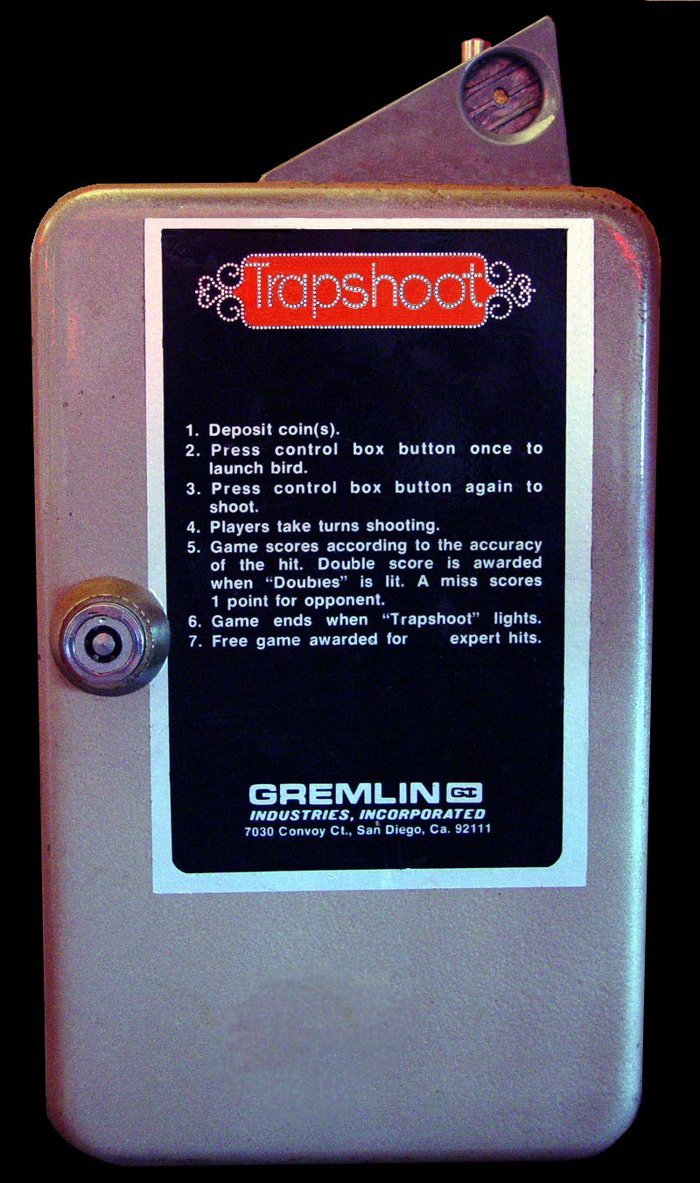
The owner's manual for TRAPSHOOT (Model 5001A, revised February 1977) gives the company's address as 8401 Aero Drive, San Diego; the instruction card on the coin box reads 7030 Convoy Ct.
What's in the box
| Cabinet | A single wall-mounted unit. Behind the printed backglass sits one large printed circuit board - 2.5 by 5 feet - holding the lamps, with plug-in Logic and Power/Sound boards. |
|---|---|
| Controller | A hand-held, tone-modulated 27 MHz radio transmitter with one push button on top. Players pass it back and forth and can play "from any place in the room." |
| Coin box | A separate quarter-acceptor box with the instruction card. The games counter stores up to four games (GAME 1 to GAME 4 on the board). |
| Lamps | #1813 (14.4 V, 100 mA) and #756 (14.4 V, 80 mA) bulbs. The manual warns: never use a lamp rated for lower voltage or higher current. |
| Logic | 7400-series TTL: counters, decoders, flip-flops, a magnitude comparator, and NE555 timers for the clocks. |
How it thinks
Everything below comes from the "Detailed Circuit Description" section of the owner's manual.
Launching a bird
The first press of the transmitter button does three things at once. A fast-toggling flip-flop freezes, picking the left or right traphouse at random. A counter that is constantly cycling through four timing capacitors stops, and the one it lands on sets how long the READY light stays on - a random delay before launch. And the master clock, which keeps sweeping through four resistor values, locks onto one of them: that is the bird's speed for this shot. Four speeds, picked at random.
The shooter follows the traphouse. A bird from the left traphouse is fired on by Station C, the shooter on the right; a bird from the right is fired on by Station A. When DOUBLES is lit, both traphouses launch and the center shooter, Station B, takes the shot.
The bird that never turns around
The flight is driven by an up/down counter and a 4-to-16 line decoder lighting 16 transistors in turn. At the end of the row the counter reverses and runs back. That should send the bird back where it came from - but the 32 bird lamps are wired to two separate power busses, with the second half of the arc wired in reverse order. When the counter turns around, the board switches busses, and the bird keeps flying in the same direction across the whole sky. In DOUBLES both busses are on, and two birds fly at once.
Was it a hit?
The second press starts the gunshot: lamps chase up the shooter's printed bullet line. When the bullet reaches the point where its line crosses the bird's path, the board opens a "gate" pulse exactly as long as one step of the bird. If the bird is sitting on that crossing lamp at the same moment, the two pulses overlap - and the size of the overlap is the score. A faster clock running four times the bird's rate counts how many pulses fit through: perfect overlap passes four (an EXPERT hit), less overlap passes three, two, or one at 25 percent. No overlap, no hit - and the bird finishes its flight.
Scoring
A hit lights the burst and steps the HIT SCORE coins up one by one, 1 through the score earned. In DOUBLES the same pulses are counted twice. A miss awards one point to the other team when the bird's flight ends. Every fourth time Team 1 comes up, the DOUBLES circuit switches on.
A 4 lights the big EXPERT trophy, triggers the crowd noise, and adds a small cup to the tally board. A preset number of EXPERT hits in one game - set by jumpers from 1 to 16 - earns a free game.
Game over
The game ends when either team reaches a score set by jumpers on the logic board - any multiple of ten up to 70 - but only after Team 2 has had its last turn. A five-second timer steps the games counter down; if more games are stored, the scores reset and the next game starts with Team 1. The coin box sums it up: "Game ends when 'Trapshoot' lights."